Fragrance 101
What Is ScentTrek? How Perfumers Capture a Living Plant's Scent
Tom Ford Ombre Leather
Tom Ford’s new Ombré Leather Reserve opens on a note called Silver Juniper ScentTrek, captured from a tree growing in the Chisos Mountains. If that sounded like marketing filler on first read, it isn’t. ScentTrek is a real, specific piece of hardware, and how it works explains why the note is described as changing over the course of a day instead of smelling like one fixed thing.
What Does ScentTrek Actually Do?
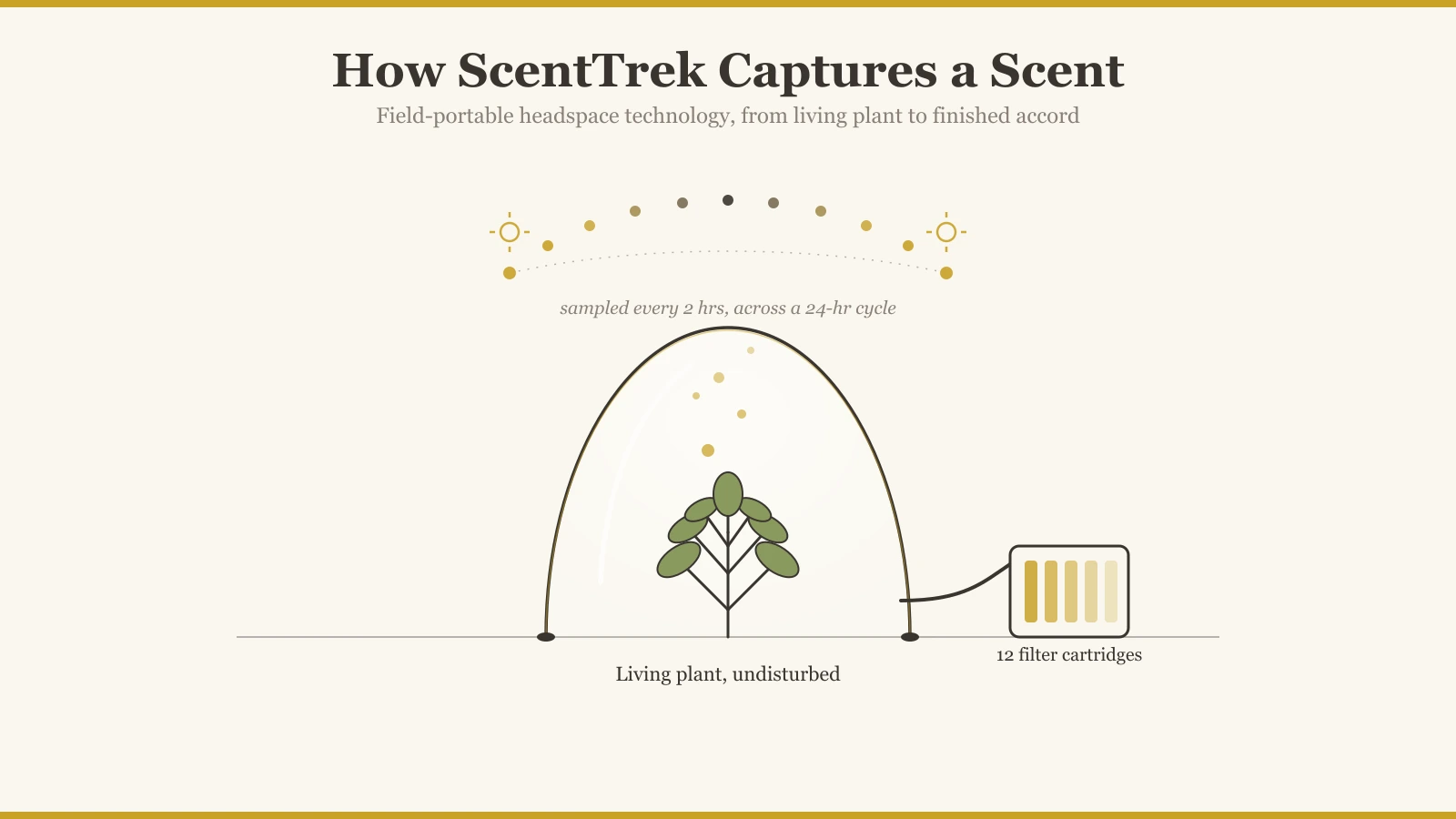
ScentTrek is Givaudan’s headspace-capture device: a clear dome, light enough to carry into the field, that seals around a living branch without cutting it. Air is drawn through 12 filter cartridges that trap the volatile molecules drifting off the plant. The device is sensitive down to a billionth of a gram, so it picks up compounds no lab extraction would ever isolate.
Nothing about the plant is damaged in the process. That’s the whole point. Some materials smell completely different once you distill or solvent-extract them, and some source plants are too rare or too fragile to harvest at all. ScentTrek reads the scent where it’s actually growing and leaves the plant standing.
Why Sample Every Two Hours Instead of Once?
Because a plant doesn’t smell the same at 6am as it does at 2pm. ScentTrek takes a fresh reading every 2 hours across a full 24-hour cycle, so the data isn’t one snapshot — it’s a timeline. That’s exactly what Tom Ford’s copy is describing when it says the Silver Juniper note goes from fresh to woodier to myrrh-tinged as sunlight hits the tree — that arc is what the device actually recorded, hour by hour, as temperature and light changed the plant’s own chemistry.
A perfumer then takes that molecular timeline back to the lab, runs it through gas chromatography-mass spectrometry to identify every compound, and rebuilds an approximation using available aromachemicals and naturals. The captured air never goes in the bottle; it’s a reference for reconstructing the smell with materials a perfumer can actually work with.
How Is This Different From Regular Headspace Technology?
Older headspace technology does the same basic trick: trap the volatiles, analyze them, rebuild the scent. But it’s usually done in one fixed location, often on a cut or potted specimen, for a single capture window. ScentTrek’s contribution is portability and repetition: carry it to where the plant actually lives, and sample it enough times that you get a time-lapse instead of a photograph. Same underlying chemistry, different resolution.
Is ScentTrek Exclusive to Tom Ford?
No, and it isn’t even exclusive to fragrance houses generally. Givaudan sells ScentTrek access to whoever’s paying, Tom Ford included. Every major flavor-and-fragrance manufacturer runs its own branded version of the same concept: Takasago calls theirs Aromascope, Mane’s is Jungle Essence, Firmenich’s is NaturePrint. When a brand’s marketing copy name-drops a proprietary capture technology, it’s usually one of these four systems rebranded under that house’s name — the underlying chemistry is the same across all four; only the name changes.
The method itself is decades old and shared across the industry. What’s actually new on a given launch is just which plant somebody decided was worth 24 hours in a field with a dome over it. If you want to see how it reads on skin, Tom Ford Ombré Leather is the original this Reserve version is measured against, and the full Reserve breakdown has the rest of the note pyramid.
Ready to Buy?
Here are our top recommendations from this article.
Not sure which fragrance is you?
Take our 90-second quiz — seven questions, three picks.
Related Coverage
News
Tom Ford Ombré Leather Reserve: What's Actually New
Tom Ford's Ombré Leather gets a Reserve flanker with silver juniper ScentTrek and cypress. Here's whether it's worth buying over the original.

Guide
EDT vs EDP vs Parfum: Which One Should You Actually Buy?
Eau de Toilette, Eau de Parfum, and Parfum differ in oil concentration, not quality. Here's how to pick the right one for your budget and skin.
Guide
The Fragrance Wheel: 4 Main Perfume Families Explained
The four main fragrance families — Oriental, Woody, Floral, and Fresh — explained with examples, plus gourmand, chypre, and other ways to classify scents.